Maple Palace Chinese Restaurant, Penang: Old-School Cantonese Dining With Ambition
Penang is famous for hawker food, but its Chinese dining scene extends well beyond smoky noodle stalls and crowded coffee shops. At Maple Palace, dinner takes a more polished, banquet-style direction, with Cantonese dishes designed for sharing, lingering and ordering just a little more than the table can handle.
Maple Palace sits on Jalan Sultan Ahmad Shah, just outside the heart of George Town, in the sort of location that feels slightly removed from the chaos of the tourist core. There are no plastic stools spilling onto the pavement here, no uncle shouting over a roaring wok, and no plate of noodles arriving before you’ve even properly sat down.
This is a different species of Penang Chinese restaurant.
Maple Palace has been around since 2009 and describes its cooking as modern Cantonese cuisine: traditional Cantonese foundations combined with Eastern and Western techniques. The restaurant is considerably more formal than the average kopitiam and is designed around group dining, private functions and banquet-style meals. The restaurant lists seating for around 250 diners, three private function rooms, smart-casual dress and an approximate spending range of RM80–RM100 per person.
And that tells you something important before you even open the menu.
Maple Palace isn’t really built around the solo traveller looking for one legendary bowl of noodles. It is built around the Chinese dining table.
The big round one.
The one where somebody orders too much food, somebody complains that there isn’t enough food, and somehow everyone goes home carrying leftovers.
The Environment: Victorian Chinese Banquet Energy
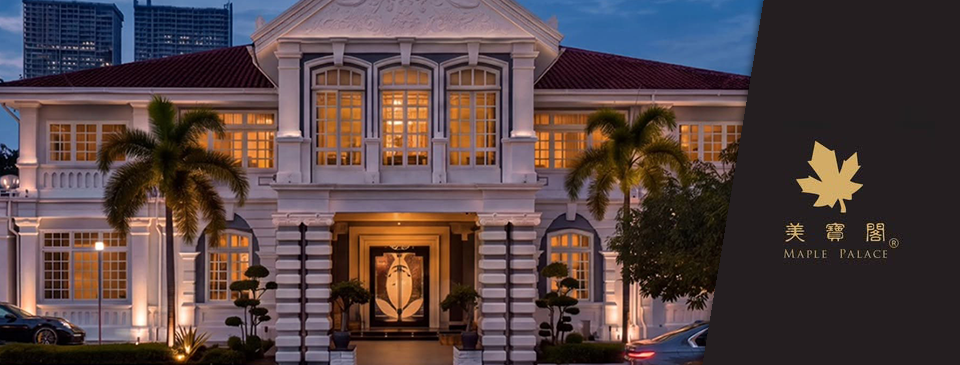
Maple Palace occupies an interesting middle ground between traditional Chinese restaurant and polished fine-dining room.
The atmosphere leans towards formal Chinese dining rather than hip George Town café culture. There is Chinese decorative influence, mixed with a more European/Victorian visual vocabulary, creating a room that feels deliberately grand without going completely palace-themed. Recent descriptions of the interior similarly point to this combination of Chinese and Victorian elements.
That distinction matters.
You don’t come here expecting exposed brick, rattan chairs and a handwritten chalkboard menu.
You come expecting proper tables, proper service and dishes designed to be shared.
It is the kind of restaurant where a family birthday dinner makes sense. So does a business lunch. So does the slightly terrifying situation where someone says, “Let’s just order a few dishes,” and fifteen minutes later there are enough plates on the table to feed a football team.
The location on Jalan Sultan Ahmad Shah is also useful. You’re close enough to central George Town to make it part of a heritage-area food crawl, but far enough away from the most congested tourist streets that you don’t feel as though you’re eating inside a human traffic jam.
And thankfully, parking is far less ridiculous than in the deepest parts of old George Town. Maple Palace has plenty of parking spaces within its own compound, which makes arriving by car considerably easier, especially for families, larger groups and diners attending busy lunch or dinner services.
It may not be effortless during peak periods, but having ample on-site parking is a major advantage.
That is an important distinction in Penang.
What Should You Order?
If you’re coming to Maple Palace for the first time, don’t make the mistake of ordering like you’re at a neighbourhood economy rice stall.
This is a restaurant where the menu makes much more sense when shared.
The dishes that repeatedly emerge as highlights include the Iberico char siew, Iberico pork ribs, Peking duck, seafood soups, steamed fish preparations and various banquet-style Cantonese creations. Recent dining reports have particularly singled out the Iberico char siew and pork ribs, while the restaurant’s broader menu leans heavily into seafood, roast meats and contemporary Cantonese cooking.
1. Iberico Char Siew
This is where I’d start.
Char siew is one of those dishes that sounds simple until somebody gets it spectacularly right.
The target is a very particular combination: caramelised exterior, tender pork underneath, enough fat to keep everything juicy, and a sweet-savoury glaze that doesn’t turn the meat into candy.
Maple Palace uses Iberico pork for its version, and recent diners have described it as one of the restaurant’s strongest dishes.
The appeal is obvious.
Good char siew should have that slightly sticky edge where the glaze catches the heat and becomes almost lacquer-like. Bite through the darker exterior and you should hit meat that remains soft and juicy rather than fibrous.
This is the dish I’d use as the restaurant’s measuring stick.
If a Chinese restaurant can’t make excellent char siew, I become suspicious of everything else.
Fortunately, Maple Palace appears to understand the assignment.
2. Peking Duck
Peking duck is another major reason to bring a group.
The best part of the bird is, obviously, the skin.
You want that delicate crackle when the knife meets it, followed by the contrast of rich duck underneath. The pancake needs to be soft rather than rubbery, and the sauces need to support the duck instead of drowning it.
Maple Palace’s Peking duck has been a recurring favourite among diners, although recent feedback has also been more measured, with some finding it good without considering it especially memorable.
And honestly, that’s useful information.
Peking duck is one of those dishes where expectations become dangerous. Once a restaurant advertises it as a signature, diners arrive expecting Beijing-level theatre.
I’d order it.
But I wouldn’t build the entire meal around it.
The char siew is the safer bet if you want the dish most likely to make you lean back and say, “Okay, that’s why we’re here.”
3. Seafood Soup
If there is one category that makes sense for a Cantonese restaurant of this style, it is soup.
Not the thin, clear broth you drink absent-mindedly.
I’m talking about the sort of soup that arrives looking almost luxurious: seafood, fish maw, crab elements and a broth with enough body to make you slow down.
One documented Maple Palace preparation combines crabmeat, cordyceps, whelk and fish maw in a rich broth built from long cooking of pork, chicken and dried scallops.
This is very traditional banquet logic.
Soup comes first because Chinese banquet cooking understands something Western restaurant menus sometimes forget: you can create richness without relying entirely on butter and cream.
The depth comes from time.
Stock.
Dried seafood.
Poultry.
Pork.
The sort of ingredients that make the kitchen smell like someone has been cooking since before you arrived.
4. Steamed Fish
For me, steamed fish is one of the great honesty tests of a Cantonese kitchen.
There is nowhere to hide.
A heavily sauced dish can distract you. A deep-fried dish can distract you. A roast can be rescued by glaze.
Steamed fish cannot.
The fish has to be fresh.
The steaming has to be precise.
The soy needs to be balanced.
And the hot oil needs to arrive at exactly the right moment.
Maple Palace has been noted for Cantonese-style steamed fish, including a whole marbled goby served with cuttlefish balls, aromatic aged soy and hot oil.
When this style of fish is done correctly, the flesh should separate almost reluctantly from the bone, soft and moist rather than mushy.
You should get the perfume of ginger and spring onion before the fish reaches your mouth.
Then comes the soy.
Then the hot oil.
Then that clean sweetness of the fish.
It’s simple food.
Which is precisely why it is difficult.
The Standouts — And Where Things Get Wobbly
Here’s where I would resist turning Maple Palace into some mythical “best Chinese restaurant in Penang” fantasy.
It clearly has serious strengths.
But the experience isn’t universally flawless.
Recent feedback has praised the food, particularly the Iberico meats, while other diners have criticised individual dishes for being expensive relative to execution. One recent diner, for example, found the cereal prawns heavy and greasy and thought the Peking duck was merely good rather than exceptional. Another praised the food and service but felt some dishes were rushed when dining close to the end of lunch service.
That tells me something useful:
Timing matters.
Don’t arrive five minutes before the kitchen wants to close and expect the full orchestra.
Chinese banquet cooking works best when the kitchen has room to breathe.
Likewise, service appears generally strong, but there have been occasional complaints about staff needing more training in the finer points of table service.
For a restaurant positioned at this price level, those details matter.
If you’re paying RM100-ish per person, you aren’t merely paying for ingredients.
You’re paying for choreography.
The soup should arrive properly.
The fish shouldn’t sit around.
The roast meat shouldn’t lose its texture while everyone waits.
And someone should know what is happening at your table.
The Taste Test: What Maple Palace Is Trying To Do
The most interesting thing about Maple Palace is that it isn’t trying to be a humble neighbourhood Cantonese restaurant.
It is deliberately more polished.
The kitchen takes familiar Chinese dishes and dresses them up.
Sometimes that works beautifully.
The Iberico sweet-and-sour pork is a good example. A reported version combines crisp, juicy pork with sweet-and-sour glaze and pomelo, giving the familiar dish a more contemporary lift.
That’s the kind of modernisation I like.
Don’t change the soul of the dish.
Just sharpen it.
You still want the sweet-and-sour punch.
You still want fried pork.
You still want the sauce clinging to the meat.
But the pomelo gives the dish a citrusy bitterness and freshness that keeps the whole thing from becoming heavy.
Then there are dishes where the restaurant pushes further into presentation and technique.
The “Four Seasons” creation, for example, has been presented as a combination of crispy chicken wings stuffed with tobiko, pan-fried scallops, breaded prawns and Iberico char siew salad with lotus-root crisps.
This is not grandmother’s Cantonese cooking.
But it is recognisably connected to the banquet tradition: lots of textures, several components, something crisp, something rich, something fresh.
And that is probably Maple Palace at its most interesting.
Who Is Maple Palace Good For?
Families
Excellent fit.
Especially if everyone wants something different.
Couples
Good, but potentially excessive unless you’re comfortable ordering a couple of dishes and taking leftovers.
Business lunches
Very suitable.
The formal environment, private rooms and banquet-style cooking make it naturally suited to business entertaining.
Solo travellers
Possible, but not ideal.
You’ll miss some of the restaurant’s greatest strength: sharing.
Tourists
Absolutely.
But I’d recommend coming with at least two or three other people if you want to explore the menu properly.
Serious food people
Yes — particularly if Cantonese roast meats, seafood and banquet cooking are your thing.
Pro Tips
1. Book ahead.
The restaurant itself recommends reservations, particularly given its size, private rooms and group-dining focus.
2. Come hungry.
This isn’t the place for a quick snack between attractions.
3. Go with four or more people if possible.
A bigger group lets you sample considerably more without turning dinner into an expensive food challenge.
4. Ask about the chef’s recommendations.
Especially with seafood.
Chinese restaurants often have availability that changes with the day’s market supply.
5. Don’t order everything fried.
Balance roast meats with soup, vegetables and steamed fish.
Your stomach will thank you.
6. Save room for dessert.
Maple Palace has featured desserts such as osmanthus and wolfberry jelly, with longan incorporated into the presentation.
It’s a much better way to end a rich banquet than another deep-fried something.
Maple Palace Overview Cheat Sheet
| Category | Details |
|---|---|
| Cuisine | Cantonese / Chinese, with modern influences |
| Best for | Family meals, celebrations, business dinners |
| Must-order | Iberico char siew |
| Also consider | Peking duck, Iberico pork ribs, steamed fish, seafood soup |
| Price level | Roughly RM80–RM100 per person |
| Atmosphere | Formal, polished, banquet-style |
| Dress | Smart casual |
| Seating | Around 250-seat capacity |
| Private rooms | 3 |
| Established | September 2009 |
| Reservations | Highly recommended |
| Parking | Available, but check conditions when booking |
| Best group size | 4–8 people |
How To Get There
Maple Palace is at 47, Jalan Sultan Ahmad Shah, 10050 George Town, Penang.
For visitors staying around central George Town, a Grab is the easiest option if you’re not familiar with Penang’s one-way streets.
Driving is perfectly practical too, as the restaurant has plenty of its own parking spaces.
Still, this is Penang.
“Parking available” does not mean “parking will magically appear exactly when you want it.”
If you’re attending a dinner during a busy weekend or festive period, give yourself some breathing room.
For navigation:
Address & Contact
Maple Palace Chinese Restaurant
47, Jalan Sultan Ahmad Shah
10050 George Town
Penang, Malaysia
Telephone: +60 4-227 9690
Additional numbers listed by the restaurant: +60 4-227 4542 and +60 4-227 9640.
Opening hours:
Daily
Lunch: 12:00pm–2:30pm
Dinner: 6:00pm–10:00pm
The Verdict
Maple Palace leans toward high-end Chinese dining, representing a distinct side of Penang’s diverse food culture.
This is banquet Chinese cooking.
It’s about the round table.
The lazy Susan.
The soup in the middle.
The fish being lifted apart with chopsticks.
The roast meats arriving on oversized platters.
The inevitable moment when somebody says, “Don’t order more, we’re full,” immediately followed by, “Actually, maybe one more dish.”
The restaurant’s strongest argument is the quality of its better dishes, particularly the Iberico char siew and other roast-meat preparations. The kitchen also shows ambition with seafood, steamed fish and modern Cantonese combinations.
But the restaurant isn’t immune to inconsistency. Some dishes can feel less convincing than their price suggests, and service isn’t always perfectly polished.
So is Maple Palace a one-and-done?
No.
Not if you enjoy Cantonese food.
I’d return with a group rather than alone, order the char siew, add one substantial seafood or soup dish, get a proper steamed fish if the day’s selection looks good, and let the table evolve from there.
The real pleasure of Maple Palace isn’t one Instagram-famous plate.
It’s the rhythm of a Chinese banquet.
A succession of dishes.
Crisp against soft.
Sweet against savoury.
Seafood against roast meat.
Rich soup followed by something fresh.
And somewhere towards the end, when the plates are getting crowded and everyone is reaching across the lazy Susan for the last piece of pork, you remember something that Penang has always understood:
Good Chinese food is rarely meant to be eaten alone.
#MaplePalacePenang
#PenangFood
#PenangFoodie
#GeorgeTownFood
#PenangChineseFood
#CantoneseFood
#PenangRestaurant
#PekingDuckPenang
#CharSiew
#EatDrinkPenang