Kebaya Dining Room, Penang: Where Nyonya Food Gets Dressed Up Without Losing Its Soul
There are two ways to approach Peranakan food in George Town.
The first is to find a plastic table, sit beneath a fluorescent tube light, order something that has been simmering since before you arrived, and eat until your shirt needs rescuing from the sambal.
The second is Kebaya Dining Room.
Kebaya takes the familiar language of Penang Nyonya cooking — belacan, tamarind, coconut, lemongrass, turmeric, chillies, buah keluak, the deep aromatic paste that makes your nose understand dinner before your tongue gets involved — and puts it into a considerably more polished setting.
And polished is the important word here.
This is not the kind of place where you come expecting your grandmother’s kitchen reproduced exactly on a plate. Kebaya is interested in what happens when classic Straits Chinese and Indo-Chinese flavours are treated with modern European technique. The restaurant itself describes its cooking as a new approach to classic Straits Chinese Nyonya dishes, refined with French techniques and contemporary ingredients.
That makes Kebaya an interesting proposition in Penang, where authenticity is sometimes treated like a competitive sport.
Because here, the question isn’t simply, “Is this traditional?”
The more interesting question is: does the food still taste like Penang?
For the most part, yes.
And it does so in a room that is almost ridiculously pretty.
The Setting: Peranakan Grandeur Without the Museum Dust
Kebaya occupies part of the Seven Terraces property at 14A Stewart Lane, tucked into one of George Town’s most atmospheric heritage pockets.
You don’t come here expecting a hawker centre.
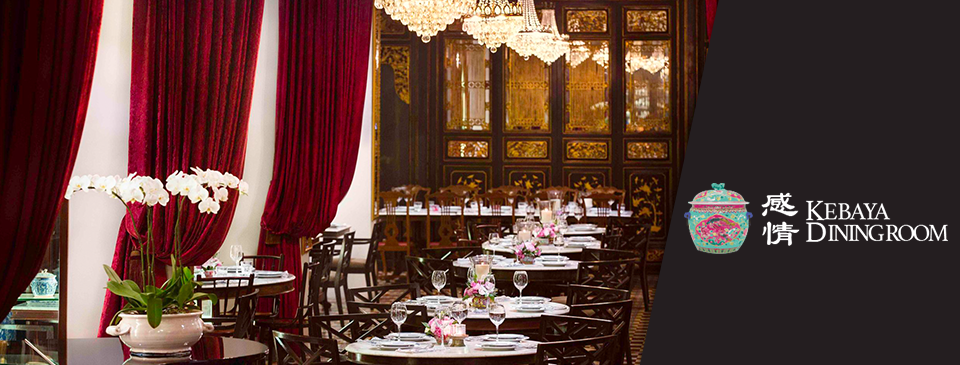
The restored building has the sort of old-world architecture that makes you instinctively lower your voice when you walk in. High ceilings, chandeliers, dark wood, rich textiles and scarlet accents give the dining room a theatrical quality without turning it into a theme park version of Peranakan culture. Contemporary descriptions of the restaurant consistently highlight its restored heritage architecture, high ceiling, chandeliers and velvet drapes.
It is grand, but not in the “look at me, I cost a fortune” way.
More old Georgetown mansion than modern luxury hotel.
And that matters.
Penang has become very good at converting heritage buildings into places where people take photographs of themselves holding cocktails. Sometimes the food becomes an afterthought.
Kebaya avoids that trap reasonably well because the dining room feels connected to the culinary story. You are surrounded by the visual language of the Straits Chinese world while eating food that deliberately plays with its traditions.
There is also music.
Recent diners have mentioned live traditional music and jazz-like background performances, depending on the evening, which adds another layer to the atmosphere.
The overall effect is intimate rather than rowdy.
This is not where you come after three rounds of Tiger beer looking for somewhere to shout over the traffic.
It is where you bring somebody you actually want to talk to.
What Do You Order at Kebaya?
Here’s where things get interesting.
Kebaya operates around a set-menu format, rather than the usual Penang restaurant model where you point at a menu and order enough dishes to feed the extended family.
The current reservation information states that it is set-menu only, with a minimum of one set per person. The restaurant offers two dinner seating times: 6:00pm and 8:00pm.
The clever part is that the dishes are designed to be shared.
So although everyone has their own set, the table becomes a small Nyonya tasting expedition.
And this is exactly how I would approach Kebaya.
Don’t have everybody order the same thing.
That would be like going to a dim sum restaurant and ordering six plates of har gow.
The joy here is comparison.
The Rendang Croque Monsieur
Let’s start with the dish that tells you immediately what Kebaya is trying to do.
Rendang Croque Monsieur.
Yes, you read that correctly.
This is the sort of combination that might cause your grandmother to stare at you over her spectacles.
But conceptually it makes perfect sense.
Take the rich, intensely spiced character of rendang and put it into the architecture of a French toasted sandwich. Add cheese and suddenly two culinary traditions that have absolutely no business being in the same sentence start having a surprisingly pleasant conversation.
Recent diners have singled this out as one of the more memorable starters, particularly because of the combination of rendang with blue cheese.
The important thing is restraint.
Rendang is already a heavyweight. It brings dried chillies, aromatics, coconut, spice and hours of cooking to the table. If the cheese becomes too aggressive, the whole thing collapses into rich-on-rich-on-rich territory.
When it works, however, you get something clever: savoury beef, fermented funk, creamy cheese and toasted bread, with the familiar warmth of Southeast Asian spices lurking underneath.
It is recognisably French.
It is recognisably Southeast Asian.
And it is recognisably Kebaya.
Pie Tee: Small Shell, Big Personality
If you’ve never eaten pie tee before, this is the sort of dish that makes a fine introduction.
The crisp pastry shell is traditionally filled with a savoury mixture of vegetables and other finely chopped ingredients, usually accompanied by chilli or sauce.
At Kebaya, the pie tee is one of the recurring crowd favourites.
The appeal is almost entirely about texture.
You get that delicate crackle when the shell gives way, followed by the softer, savoury filling.
Crunch first.
Then spice.
Then sweetness.
Then the aromatic finish.
It’s a small bite that behaves like it has somewhere important to be.
Recent diners repeatedly mention the pie tee as a standout, praising its crisp texture and layered flavour.
And this is where Kebaya demonstrates one of its strengths: presentation can be elaborate, but the food still needs to be fun to eat.
Pie tee should never require a lecture.
You bite.
It cracks.
Something delicious happens.
That’s enough.
Otak-Otak: Spice With a Softer Hand
Otak-otak can be a dangerous dish in the wrong hands.
Too much coconut and it becomes heavy.
Too much chilli and the fish disappears.
Too little seasoning and you’re essentially eating steamed fish paste.
Kebaya’s version is more restrained, allowing the fish to remain part of the conversation rather than simply becoming a carrier for spice.
Recent diners have specifically praised the freshness of the fish and the balance between the fish itself and the stronger aromatics.
That balance is crucial.
Good Nyonya cooking isn’t simply about making something spicy.
It is about layering.
Chilli.
Turmeric.
Lemongrass.
Shrimp paste.
Tamarind.
Coconut.
Herbs.
Acid.
Sweetness.
Each has a job.
The best dishes don’t shout all of them at you simultaneously.
Prawn Curry: The Dish I’d Keep Room For
If there is one dish that repeatedly appears in enthusiastic accounts of Kebaya, it is the prawn curry.
And I understand why.
Prawn curry is one of those dishes where the sauce is almost more important than the seafood.
You want the prawns cooked properly, certainly, but the real prize is what happens when the aromatic gravy meets rice.
Recent diners have described the prawn curry as exceptionally fragrant and deeply flavoured, with more than one guest identifying it as the standout dish of the meal.
This is the kind of food that makes you suspicious of anyone who says they are full.
Because suddenly there is another spoonful of sauce on the plate.
Then another.
Then you are scraping the bowl.
And the rice is somehow disappearing faster than you remember eating it.
That is the test.
A great curry doesn’t merely accompany the rice.
It makes the rice necessary.
The Duck: Rich, Tender and Slightly Dangerous
Kebaya’s duck dishes are another reason not to arrive already stuffed.
The restaurant has served versions including duck confit and Itik Sio, while recent diners have praised the duck for being tender and richly flavoured.
Duck confit is an interesting technique to bring into a Nyonya setting because it changes the texture completely.
Instead of the meat being aggressively spiced into submission, the slow-cooked duck becomes soft and yielding, while the accompanying Nyonya flavours supply the punch.
This is modernisation done properly.
The technique changes.
The flavour vocabulary doesn’t disappear.
Beef and Buah Keluak: For the Curious
Then there is buah keluak.
If you’ve never encountered it, welcome to one of Southeast Asia’s more fascinating ingredients.
The black nut has an earthy, bitter, almost chocolate-meets-fermented quality that is unlike anything else in the pantry.
It is not shy.
It doesn’t politely introduce itself.
It walks into the room and announces its presence.
Kebaya has paired buah keluak with beef in dishes such as its Confit Beef Buah Keluak Jam, bringing a very traditional Peranakan flavour into a more contemporary format.
For first-timers, this is precisely the kind of dish worth ordering.
Not because it is necessarily the easiest thing on the menu.
Because it isn’t.
But because this is what makes Peranakan food so interesting.
The cuisine isn’t built around one-note sweetness or generic curry powder.
It has strange, fermented, bitter, sour, spicy and aromatic corners.
Kebaya gives those corners some fine-dining furniture.
The Greens Matter More Than You Think
A common mistake with a big tasting meal is to treat vegetables as the boring course you endure before dessert.
Don’t.
Nyonya vegetable dishes can be some of the most expressive plates on the table.
The combination of greens, coconut, nuts, sambal and aromatics gives vegetables a complexity that makes the Western idea of “side dish” feel almost insulting.
Recent diners have particularly mentioned grilled eggplant and mixed vegetables with peanut sauce among the memorable dishes.
Eggplant, especially, is a wonderful canvas for Southeast Asian flavours.
Get it right and the flesh becomes almost creamy.
Then comes char.
Then sauce.
Then spice.
Then you realise you’ve eaten half the vegetable dish while waiting for the meat.
And Then There Is the Chicken
Ayam goreng is one of those dishes that doesn’t need an explanation.
Fried chicken is universal.
But good ayam goreng is about the seasoning getting into the meat and the exterior retaining enough texture to make every bite interesting.
Recent guests have repeatedly called the fried chicken a standout.
And this is an important point about Kebaya.
For all the chandeliers and heritage architecture, it doesn’t seem desperate to make every dish complicated.
Sometimes fried chicken is exactly what you want.
Crisp.
Savoury.
Spiced.
Juicy.
Put it next to curry and rice and suddenly the fancy dining room makes sense.
The Good
The cooking has a point of view
Kebaya isn’t simply reproducing old Nyonya recipes.
It is interpreting them.
That will appeal to diners who already know Peranakan food and want something slightly different.
The setting is genuinely special
There are plenty of restaurants in George Town where the heritage building is doing all the heavy lifting.
Here, the room and food actually belong together.
The service is a strength
Current guest feedback is particularly positive about the hospitality, with several recent diners describing staff as attentive, knowledgeable and helpful with menu explanations and dietary requirements.
That matters more than people realise.
A tasting menu can become frustrating if nobody tells you what is coming.
Portions are generous
This is not the kind of tasting menu where you finish the final course and immediately start Googling the nearest nasi kandar stall.
Multiple recent diners have commented that the portions are substantial, sometimes to the point where dessert becomes difficult.
Come hungry.
Seriously.
The Not-So-Good
Kebaya is not cheap.
And it isn’t trying to be.
That means the comparison isn’t with a RM8 plate of assam laksa around the corner.
It is with other destination restaurants.
If your idea of the perfect Penang meal involves plastic chairs, a sweaty forehead and change from RM20, save Kebaya for another evening.
There is also the question of authenticity.
Some diners love the modern interpretation precisely because it isn’t conventional Peranakan cooking. Others find some dishes less traditional than expected.
I think that criticism needs to be understood rather than dismissed.
Kebaya is not pretending to be an old-school kopitiam.
It is an interpretation.
If you want strict tradition, there are other places in Penang.
If you want tradition filtered through contemporary restaurant technique, this is much more interesting.
A few guests have also mentioned occasional issues with pacing or food temperature.
That isn’t enough to define the restaurant, but it is worth remembering that a polished dining room still has human beings running it.
Who Is Kebaya Good For?
Couples
Excellent.
This is probably one of the strongest use cases.
The atmosphere encourages conversation and the setting feels sufficiently special for an anniversary or date.
Families
Also good, particularly if everyone is comfortable sharing.
The family-style presentation means you can sample several different flavours.
First-time visitors to Penang
Very good.
Kebaya gives you an introduction to several Peranakan flavours without requiring you to understand the entire culinary history beforehand.
Hardcore Penang food hunters
This is where opinions may divide.
If you have spent years eating Nyonya food in tiny family-run kitchens, some of Kebaya’s reinterpretations may feel a little too dressed up.
But that is precisely why it is worth visiting.
You aren’t coming to replace those places.
You’re coming to see what happens when somebody takes the same culinary vocabulary somewhere else.
Insider Tips
Book ahead.
The restaurant currently operates two dinner seatings, at 6pm and 8pm, and reservations are recommended.
Arrive hungry.
Portions are generous.
Don’t duplicate dishes.
If you’re dining with friends, use the menu’s sharing format to explore different starters and mains.
Ask about dietary requirements before arriving.
The official reservation page notes that the menu contains eggs, soy sauce, nuts, dairy, gluten and seafood, and asks guests with special dietary requirements to contact the restaurant.
Leave space for dessert.
This is easier said than done.
Several diners have admitted defeat before dessert because the savoury courses were so generous.
If pandan creme brûlée or another dessert special is available, don’t automatically assume you’re too full.
You will regret being sensible.
Overview Cheat Sheet
| Category | Details |
|---|---|
| Restaurant | Kebaya Dining Room |
| Cuisine | Modern Peranakan / Straits Chinese Nyonya |
| Location | Seven Terraces, Stewart Lane, George Town |
| Setting | Heritage mansion, elegant and intimate |
| Format | Set menu / sharing-style dining |
| Dinner | Daily, 6:00pm–10:30pm |
| Seatings | 6:00pm and 8:00pm |
| Must-try territory | Prawn curry, pie tee, otak-otak, ayam goreng, duck, beef/buah keluak |
| Best for | Dates, celebrations, visitors, food-curious groups |
| Price feel | $$$$ / special-occasion territory |
| Dress vibe | Smart casual to dressed-up |
| Booking | Strongly recommended |
| Overall mood | Heritage Georgetown with polished Nyonya cooking |
How To Get There
Kebaya Dining Room is at 14A Stewart Lane, within the Seven Terraces property in central George Town.
If you’re staying around Armenian Street, Lebuh Chulia, Campbell Street or the core heritage zone, walking is perfectly realistic and, frankly, preferable.
This part of George Town is best experienced on foot.
You get the shophouses.
The five-foot ways.
The old walls.
The scooters squeezing past.
The smell of incense mixing with frying garlic.
The slightly sticky Penang evening air.
Then you arrive somewhere considerably more civilised.
For visitors staying farther away, Grab is the painless option.
Driving yourself is possible, but this is George Town, where “there is parking nearby” can mean anything from a legitimate parking space to a spiritual belief.
Don’t build your evening around finding a perfect spot directly outside the restaurant.
If you’re coming by car, allow extra time.
And if you’re celebrating something, simply take a Grab.
The stress saved is worth more than the parking fee.
Address & Contact
Kebaya Dining Room
14A, Stewart Lane
10200 George Town
Penang, Malaysia
Telephone: +604 264 2333
Mobile: +011 1403 3310
Email: [email protected]
Current dinner hours: Daily, 6:00pm–10:30pm
Seatings: 6:00pm and 8:00pm
Official website: kebaya.com.my
The Verdict: Weekly Staple or One-and-Done?
Kebaya is not the restaurant I would send someone to if they had only one evening in Penang and wanted the cheapest, dirtiest, most delicious plate of noodles they could find.
There are other battles for that crown.
But if you want to understand another side of Penang food culture — the side with heritage architecture, polished service, carefully constructed dishes and Nyonya flavours that have been given room to evolve — Kebaya makes a compelling case.
The restaurant’s greatest strength is that it understands something many “modern Malaysian” restaurants occasionally forget:
Modern doesn’t have to mean abandoning the past.
A prawn curry can still taste unmistakably Southeast Asian while being served in a room with crystal chandeliers.
A piece of pie tee can still crackle with the memory of somebody’s grandmother’s kitchen even when it arrives on a carefully composed plate.
Buah keluak can remain gloriously strange.
Sambal can remain dangerous.
And fried chicken can still make everybody at the table suddenly stop talking.
That is what I like about Kebaya.
It dresses Nyonya food up.
But underneath the nice clothes, there is still chilli, coconut, belacan, tamarind, spice and all the wonderfully complicated history of the Straits.
Would I call it a weekly Penang staple?
No.
For that, I’d rather keep my hawker-stall muscles exercised.
Would I return for a birthday, anniversary, visiting-foodie dinner or one of those evenings when you want George Town to put on its best kebaya?
Absolutely.
Kebaya is a special-occasion restaurant that earns its special occasion.
And in a city where heritage has become a very fashionable word, that’s no small achievement.
#KebayaDiningRoom
#KebayaPenang
#PenangFood
#PenangFoodie
#NyonyaFood
#PeranakanFood
#GeorgeTownPenang
#PenangEats
#MalaysiaFood
#PenangRestaurant