Four Hands, George Town — Modern Dim Sum Without the Old-School Banquet-Hall Fuss
There is something slightly dangerous about a dim sum restaurant that looks this polished.
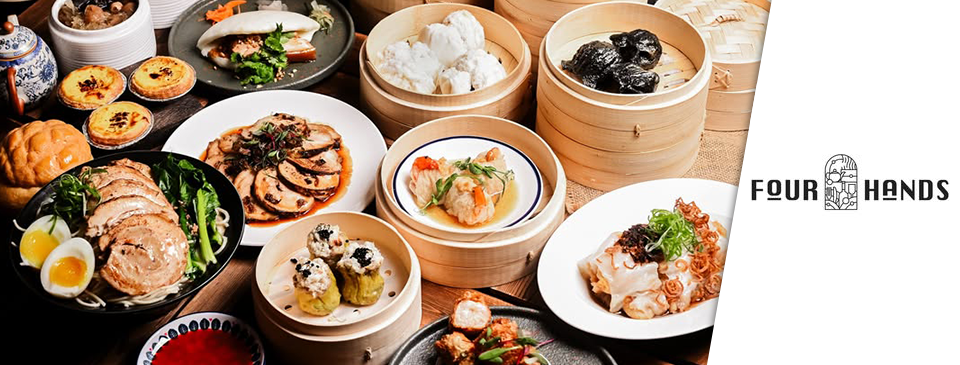
You walk into Four Hands expecting the usual Penang morning ritual—clattering bamboo steamers, elderly uncles arguing over tea, trolleys trundling between tables—and instead you get something altogether more contemporary. The setting is neat, the presentation is careful, and the menu takes the familiar Cantonese vocabulary of har gao, siew mai, chee cheong fun and turnip cake and gives it a little modern polish.
But this isn’t dim sum trying desperately to become fine dining. That distinction matters.
Four Hands, at 10 Jalan Burma, has carved out a niche as a more refined, relaxed place for dim sum, breakfast and lunch, operating daily from 8am to 6pm.
And yes, there are gold-leaf-topped har gao and Guinness pork-belly buns.
Penang has officially entered its atas dim sum era.
The Quick Verdict
| Restaurant Name | Four Hands |
| Cuisine | Modern Cantonese / Dim Sum |
| Address | 10, Jalan Burma, 10050 George Town, Penang |
| Opening hours | Daily, 8:00am–6:00pm |
| Phone | +60 17-692 4338 |
| Price guide | Roughly RM20–RM50 per person |
| Best for | Families, brunch dates, visitors wanting polished dim sum |
| Must-order | Har gao, creative chee cheong fun, Guinness pork belly bun |
| Halal? | No — pork is present |
| Vibe | Contemporary, comfortable, slightly fancy without being stiff |
The Environment: Dim Sum, But Make It George Town
Four Hands sits on the corner of Jalan Burma and Jalan Transfer, a useful location if you’re exploring the northern edge of George Town rather than sticking exclusively to the postcard-heavy Armenian Street circuit. The address is a proper urban Penang one: traffic, old buildings, pedestrians, the occasional motorbike threading through the morning bustle.
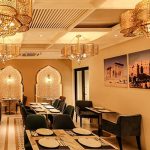
Inside, Four Hands deliberately distances itself from the traditional dim sum hall.
There’s less of the “AUNTIE, ONE MORE HAR GAO!” chaos and more of a contemporary restaurant atmosphere. It feels designed for lingering rather than simply wolfing down three bamboo baskets before the next customer claims your chair.
That is both its strength and, depending on your expectations, its slight weakness.
Traditional Penang dim sum has theatre. There’s something wonderfully democratic about sitting shoulder-to-shoulder with families while steam fogs the windows and somebody at the next table orders enough char siu bao to feed a school.
Four Hands instead gives you breathing room.
It’s the sort of place where you could bring your parents, a visiting friend from Singapore, or somebody you’re quietly trying to impress.
And nobody needs to know you ordered three baskets of dumplings.
What Are the Must-Orders?
This is where Four Hands earns its keep.
The menu doesn’t simply run through the standard dim sum checklist. There are familiar classics, but the kitchen clearly enjoys playing with fillings, sauces, textures and presentation.
1. Har Gao — The One I Would Start With
The har gao is the obvious test.
A good har gao needs very little: translucent wrapper, sweet prawns, proper seasoning and enough structural integrity that it doesn’t collapse the moment your chopsticks touch it.
The published description of Four Hands’ version notes a delicate wrapper, fresh-tasting prawn and a small touch of gold leaf.
Gold leaf, admittedly, is not going to make a prawn taste better.
But if the underlying dumpling is right, it becomes harmless theatre rather than culinary nonsense.
And that’s the important distinction here.
The prawn should be the star: sweet, springy and juicy, with the wrapper providing just enough chew to hold everything together. This is the kind of har gao where you realise halfway through eating it that you’ve stopped talking.
That’s the compliment.
2. Siew Mai
Siew mai is one of those dishes where restaurants reveal themselves.
Because everybody has eaten a mediocre one.
Too much filler and not enough meat? Bad.
Over-steamed until the wrapper goes floppy? Bad.
Seasoned like somebody was afraid of salt? Also bad.
Four Hands’ siew mai has been described as well-seasoned and satisfying, though less hefty than some of Penang’s more traditional versions.
That’s a useful way to think about it.
This isn’t necessarily the giant, meat-packed siew mai designed to make you feel you’ve consumed a small pork mountain. Four Hands goes for refinement.
And if you’re sharing, that’s probably exactly what you want.
3. Chee Cheong Fun — Don’t Skip This
This is where things become more interesting.
Four Hands has a rolled chee cheong fun with crispy prawns, alongside its Hong Kong-style chee cheong fun. The former has been singled out as one of the more memorable dishes from the menu.
And I understand why.
Classic chee cheong fun is all about softness: silky rice sheets, sweet sauce, sesame, perhaps shrimp or char siu depending on the style.
Then somebody comes along and says:
“What if we put something crispy in there?”
Suddenly the dish has architecture.
Silky rice noodle.
Crunchy prawn.
Sauce.
Softness.
Crunch.
It’s the sort of contrast that makes modern dim sum work without becoming gimmicky. I personally like this alot.
4. Guinness Pork Belly Bun
Now we get to the dish that sounds like it was invented after someone stared at a Guinness bottle and thought, “You know what would be good with this?”
Guinness pork belly bun — The idea is straightforward: fluffy steamed bun, tender pork belly, caramelisation and the dark maltiness of stout.
And frankly, pork belly and Guinness are old friends.
The stout contributes bitterness and roasted depth, while the pork brings fat and sweetness. Put both inside a soft bun and you’ve got something considerably more indulgent than your average char siu bao.
This is not the dish I’d order if I wanted to prove how disciplined I am.
It is absolutely the dish I’d order if somebody said:
“Let’s get one more thing for the table.”
The Supporting Cast
Four Hands also does the less glamorous work reasonably well.
There’s pan-fried turnip cake, HK chee cheong fun, scallop and prawn beancurd rolls, braised chicken feet, lotus-leaf rice, stir-fried pork belly noodles and vegetables such as stir-fried kailan with garlic.
The important thing is not to treat the menu like a checklist.
Four Hands is better approached as a sharing meal.
Two people can order four or five dishes.
Four people can go considerably more dangerous.
Six people?
Someone is going to order the entire menu and then pretend it was an accident.
The Taste Test: Where Four Hands Makes Its Case
The biggest strength here is texture.
Dim sum lives or dies on texture.
The har gao needs that slight resistance from the wrapper before yielding to the prawn.
The chee cheong fun needs to be soft without becoming mush.
The turnip cake needs a browned exterior with a tender interior.
The pork belly needs to be rich without becoming a block of fat.
That’s why Four Hands’ modern approach works when it works. The kitchen isn’t reinventing Cantonese cuisine. It’s concentrating on the things that make familiar dishes pleasurable and then adding another layer.
There’s also a nice balance between traditional savouriness and modern sweetness.
You get pork.
You get seafood.
You get fermented and umami-rich sauces.
Then you get little flashes of sweetness, acidity or spice to stop the whole meal from becoming one long beige procession of steamed carbohydrates.
And yes, chilli sauce matters.
One customer account describes Four Hands’ house chilli as being made with two fruits, with the explanation that this helps reduce the amount of sugar used.
That sort of detail tells you something about the restaurant.
They’re thinking about the condiment rather than treating it as an afterthought.
Good dim sum restaurants understand this.
A great chilli sauce can rescue a respectable dumpling.
A bad one can make a good dumpling taste like a petrol station snack.
The Good & The Bad
Let’s be fair.
Four Hands isn’t trying to be the cheapest breakfast in Penang.
If your benchmark is a traditional kopitiam where RM20 gets you enough food to require a nap afterwards, this isn’t that restaurant.
The pricing is more comfortable than bargain-basement, particularly if you start ordering the premium or specialty dishes.
But you are paying for more than food.
You’re paying for a more comfortable environment, more careful presentation, and a menu that takes some creative liberties with familiar dishes.
That’s perfectly reasonable.
The bigger question is whether those refinements actually improve the meal.
For the stronger dishes—particularly the har gao and more creative chee cheong fun—the answer is yes.
The danger is over-ordering.
Dim sum restaurants encourage it.
Everything arrives in small portions, which tricks the brain into thinking:
“Surely we can have another.”
Twenty minutes later you’ve got enough food on the table to qualify as a family reunion.
Who Is Four Hands Good For?
Couples
Very good choice.
It’s considerably more date-friendly than the average old-school dim sum hall.
Families
Probably the sweet spot.
There’s enough variety for older parents, adventurous children and the one relative who refuses to eat anything “weird.”
Visitors to Penang
Absolutely.
If you’ve already had your fill of hawker-centre breakfasts and want to experience another side of Penang’s Chinese food culture, this is an easy addition.
Serious traditional-dim-sum purists
Hmm.
This is where I’d manage expectations.
If you want old-school Cantonese dim sum theatre, pushcarts, enormous portions and the feeling that the entire restaurant has been awake since 5am, Four Hands isn’t trying to compete on that field.
It’s doing something else.
Pro Tips
Go earlier rather than later.
The restaurant opens at 8am, making breakfast the obvious time to visit.
Share.
Don’t order one giant meal per person. Dim sum exists to be communal.
Start with the har gao.
It’s one of the clearest indicators of whether the kitchen is having a good day.
Add one creative dish.
The crispy-prawn chee cheong fun or Guinness pork belly bun gives you a better sense of what separates Four Hands from conventional dim sum.
Bring cash/card flexibility.
Bring both cash and a card if possible, as payment methods can vary. We recommend calling ahead to confirm.
Expect a non-halal meal.
The menu includes pork dishes, including the Guinness pork belly bun.
How To Get There
The restaurant is at 10 Jalan Burma, George Town, close to the Jalan Burma/Jalan Transfer intersection.
By Grab, it’s straightforward: use “Four Hands” or the full Jalan Burma address.
By car, this is classic George Town territory—possible, but don’t approach parking with unrealistic optimism. Street parking availability changes throughout the day, and the surrounding roads can get busy.
If you’re already exploring central George Town, walking is perfectly viable, especially from the northern heritage district.
For navigation, use the restaurant’s location at 10 Jalan Burma, 10050 George Town rather than relying solely on the restaurant name, because “Four Hands” is generic enough to produce unrelated results.
Address & Contact
Four Hands
10, Jalan Burma
10050 George Town
Pulau Pinang, Malaysia
Phone: +60 17-692 4338
Opening hours: Daily, 8:00am–6:00pm
Google Maps:
The Verdict
Four Hands is not trying to replace Penang’s legendary old-school dim sum joints.
Thank goodness.
Penang needs those places—the noisy ones, the slightly chaotic ones, the restaurants where the tables are too close together and somebody’s tea pot looks older than your parents.
What Four Hands offers is a different proposition.
It’s modern dim sum with enough respect for tradition to remain recognisably Cantonese, but enough imagination to keep things interesting.
The har gao is the place to start. The crispy-prawn chee cheong fun is the dish I’d use to explain the restaurant to someone. The Guinness pork belly bun is the wildcard. And if the table is large enough, throw in the classics, some vegetables and a pot of tea and settle in.
Is it a weekly Penang staple?
For the traditionalist, probably not.
For someone who likes dim sum but wants a little more comfort, creativity and polish?
Yes.
Four Hands occupies that increasingly useful middle ground between hawker-stall authenticity and fine-dining fussiness.
In other words: you can wear slightly nicer clothes, order another basket of dumplings, and still feel like you’re having breakfast.
That’s a pretty good Penang morning.
#FourHandsPenang
#PenangFood
#PenangEats
#DimSumPenang
#GeorgeTownFood
#PenangBreakfast
#JalanBurma
#PenangFoodie
#MalaysiaFoodie
#GeorgeTownPenang